What Makes an Adult Learner?
Where Are They? Why Are They?
I did a lot of art in college and then, when I went to graduate school for English and eventually got a job as a professor, I stopped almost completely. I would still draw things on the dry erase broad if I had a few minutes before class.
Here’s a bear I drew for a day on Jeanette Winterson’s story about each of our inner polar bears:
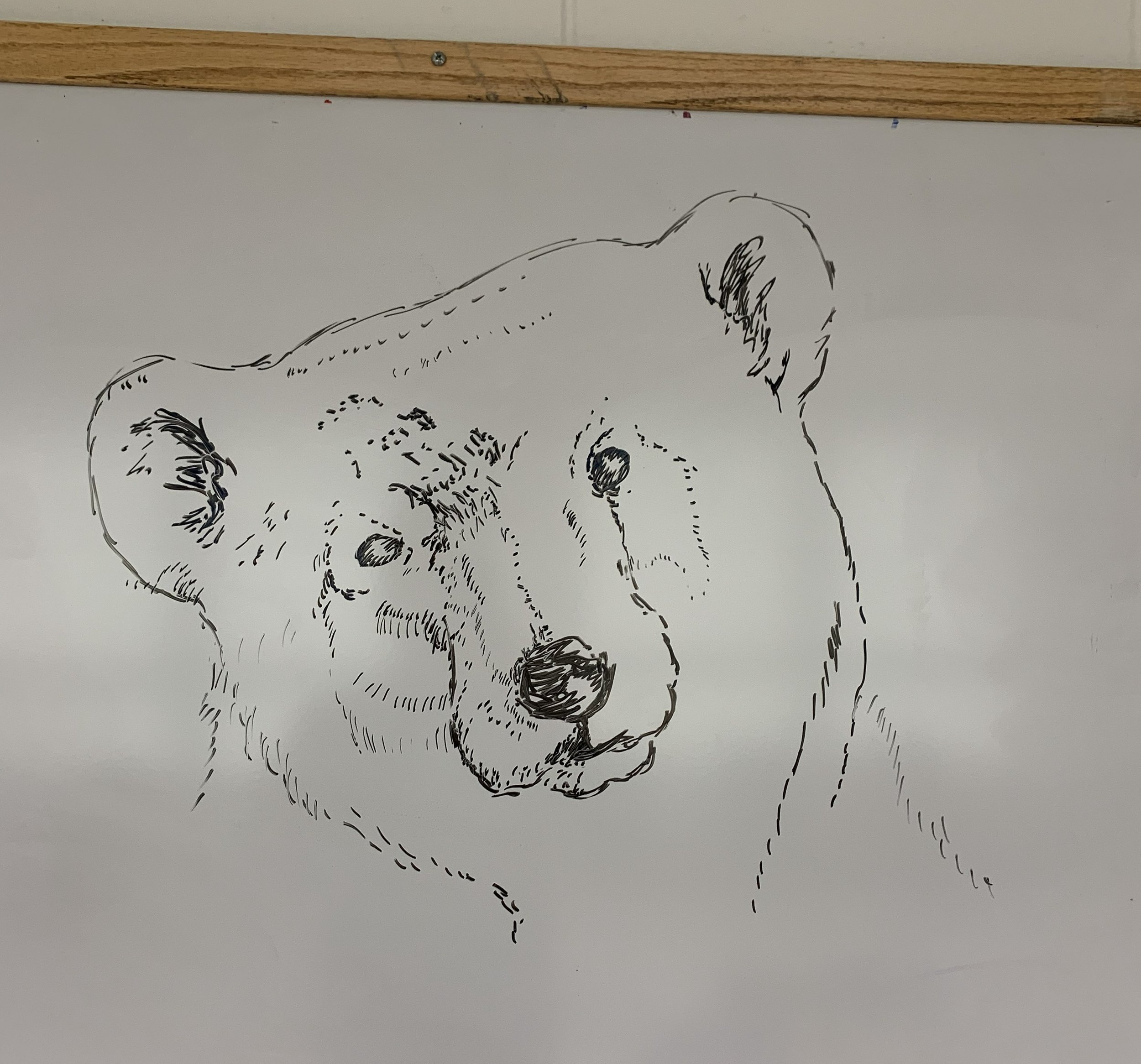
It’s a bear.
But then you hear horror stories about professors who end up with nothing at all besides being a professor and you know you need to listen to the advice that says “Get a hobby.”
So this summer I started taking a local art class called “Next Steps for the Very Beginner in Watercolor” since I hadn’t worked in watercolors since I was like thirteen years old. At that time, I was privileged to take art classes with John Coville, son of legendary Canadian artist Alex Coville.
Here are two of the first paintings from this summer’s course. Well, one and a half…
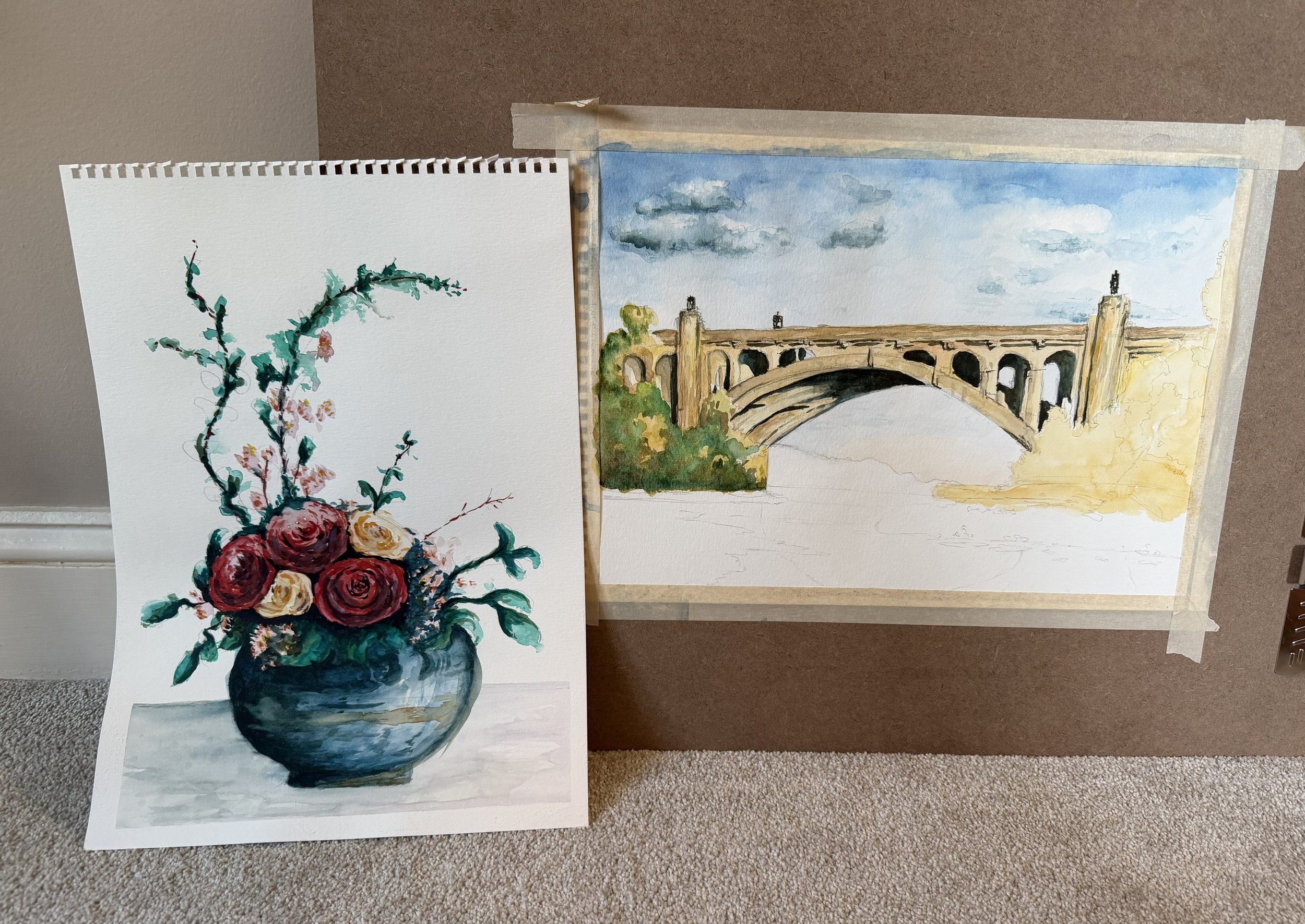
Some flowers and a disappointed bridge.
According to my watercolor teacher, the first painting is “not a watercolor although you used watercolors.” She was much more pleased with the second incomplete painting of a bridge. On seeing this one, my wife said, “Hey, it’s a bridge!” I took this to be the mark of a successful artist. I was back!
As an Adult Learner, my physical, literal Where? is Harrisburg, PA. But Where? is also a Situation. I started taking an art class for the same reason a lot of people sign up for a personal trainer; I knew I wasn’t going to get any art done without accountability to something outside myself. My social role also shaped my desire to take painting classes, for reasons similar to the accountability part of the deal. The focused concentration of painting temporarily clears away the mental stress of my work.
When they talk about Adult Learning, Laura L. Bierma et al. say that “most adults are motivated to learn to deal with an issue or problem of immediate concern” (2025, p. 202). So one part of my internal motivation is an immediate psychological concern related to my work. That’s “problem-centered learning”; work causes stress, and I need to engage in the neoliberal practice of compensatory self-care to deal with (cope with) that stress, as Theodor Adorno would point out: “While in their structure work and amusement are becoming increasingly alike, they are at the same time being divided ever more rigorously by invisible demarcation lines. Joy and mind have been expelled equally from both” (Minima Moralia, 1974, p.139 or 2.84; see Robert Miner’s nice take on this).
Another part of my motivation is that I just like art, which would seem to be “subject-centered.” So my Adult Learning in this case is a mixture of both or maybe, per Adorno, their structures are increasingly alike but they’re also rigorously divided. As most theorists of Adult Learning state, pedagogy and andragogy overlap, either Venn diagram style or even just at the edges.
There’s another kind of blending or maybe it’s fusion or synergy or mutual dynamism or pernicious reinforcement between the Where? and the Why? of Adult Learning. For the vast majority of Adult Learners, 85 to 90% in one survey, the Where? isn’t a physical place but a set of economic conditions; or maybe you could call it the visible/invisible physical place of the market (Merriam et al., 2007, as cited in Bierma et al., 2025, p. 200). Despite nuanced updates from Stuart Hall, the classical Marxist base - superstructure fits surprisingly cleanly onto this relationship, where the economic conditions determine the cultural and psychological formations of a given society. Most Adult Learners are motivated by their situation within their economic systems (the Where?). In North America, Europe, and increasingly more globally, these are some variation on neoliberalism, which makes individuals rather than societies assume risk on markets that produce winners and losers, all backed by the security apparatus of the state (see Quinn Slobodian’s work on neoliberlism/s). Adult Learners are responding to something inflicted on them by market forces (the Why?): they need to reskill or upskill or retrain or certify something, with “constant and unrelenting” changes in market forces — Jim Carroll’s “knowledge velocity” — driving things (Bierma et al., 2025, p. 32, and, 2022, as cited in Bierma et al., 2025, p. 32).
It might be objected that some of the kinds of “internal motivation” named by Adult Learners contradict so reductive an equation of learning motivation to pure economic conditions. Yes, Adult Learners mention “increased job satisfaction with one’s work, enhanced self-esteem, improved quality of life, and personal fulfillment,” and, yes, while some of these seem emotionally free-floating, almost all of them are either tethered to (“increased job satisfaction”) or at the least distantly connected to (“enhanced self-esteem”) market forces (Bierma et al., 2025, p. 200).
This fusion reaches a kind of critical mass in the rhetoric of “vocation” or being called to something (cf. “Finding a vocation,” in Bierma et al., 2025, p. 197). In the Abrahamic traditions, God or God’s messengers (angels) or God operating through another person, non-human animal or thing, issues the call (Gen. 22:2, “Take your son, your only son whom you love, Isaac, and go to the land of Moriah,” etc.). It’s something external to the world that enters into the world and changes it, often by radically contradicting the order of things. In the economic systems of neoliberal capitalism, the call can only come from within the system—you could devote your life to a “noble calling,” but the economic system has to approve of it for you to survive at a basic material level. In neoliberalism, the call is coming from inside the house.
At best, your “call” will be mediated by our economic systems; you will get paid enough to do something noble. Calls to be a painter or dancer or professor are met with direct or barely concealed ridicule because our economic systems punish those vocations. All that can really call you are market forces: break into tech, learn to code, monetize water, get that bag. Wait, don’t learn to code anymore. Scratch that. Education becomes a roulette wheel where you place bets on what skills will be needed and pray for the best. That’s where the shifting needs of Adult Learners come into perhaps crueler focus. You might have been called to code, but the call got dropped (by AI), so now you have to figure out what else “calls” you. And, if this hits in your late 30s, 40s, or early 50s, you’re in “the identity crisis” (Bierma et al., 2025, p. 197). Neoliberalism itself recodes this constant instability and precarity through talk about “grit,” “resilience,” “flexibility,” “adaptability.” The liberal arts get pitched as tools to help you navigate this house-built-on-sand (by design).
“[P]ersonal fulfillment” offers the most plausible Why? other than pure economic conditions, but even there market forces determine opportunities. I sat next to a doctor on a plane once and he talked about taking classes at the University of Chicago for fun—he enjoyed them because he wasn’t really required to complete the reading. Sounds cool. Bierma et al. present a case study where a woman and her husband have a delightful time wine tasting in France (2025, p. 211). I’m glad they had fun. While these moments seem like, and admittedly are, learning for “personal fulfillment,” the situation, the Where?, of each is predicated on the financial freedom afforded by the kinds of work done by the people in question.
From urgency and immediate need to efficiency and problem-solving and even to the psychological desire to be seen as learning equals in the Adult Learning classroom, the conditions of Adult Learning, its Where? and Why?, seem to emerge largely out of the neoliberal situation of contemporary life. Pierre Dardot and Christian Laval argue that these conditions are the “form of our existence”; neoliberalism “even transforms the individual, now called upon to conceive and conduct him- or herself as an enterprise” (2017, p.3). You are your own little company, project, or business—and you always need to be improving. In a curious way, this makes Adult Learners seem more “subject-centered” and externally determined but where some market-based skills inadequacy in “the subject” (themselves) has become the “problem” to solve. External pressures require you to generate internal motivation, as Byung-Chul Han says; you reconfigure the need to learn as “achievement” and internalize its external logics so that they seem to come from you. You think you’re a “problem-centered” learner but the “problem” to solve is really you and your market-based inadequacies.
My friend sent me a text on some affirmations to make in this kind of economic system. One read, “I do not need to monetize my hobbies; it is enough to spend time doing something I love.”
Of course, I secretly hope that, however unlikely, I might some day make a buck from painting.